
Custom accounts payable automation, built around your exact business
Steer73 builds AI-enabled accounts payable automation built around how your team actually works. No ongoing licence fees. No vendor lock-in. No generic workflows you have to adapt around.
100% personalised software, delivered quickly and cost-effectively through our Cambrian BOP platform, with project success contractually guaranteed.
Failed projects
0
Years delivering
10+
License fees
£0
IP ownership – yours, always
100%
Custom enterprise systems and
AI platforms delivered for
A better way to automate accounts payable
Steer73 builds accounts payable automations tailored to your exact workflows, integrated with your actual ERP and finance systems, and fully owned by your business. We streamline your entire AP process, without the ongoing licence fees, vendor lock-in, or generic workflows that come with off-the-shelf alternatives.
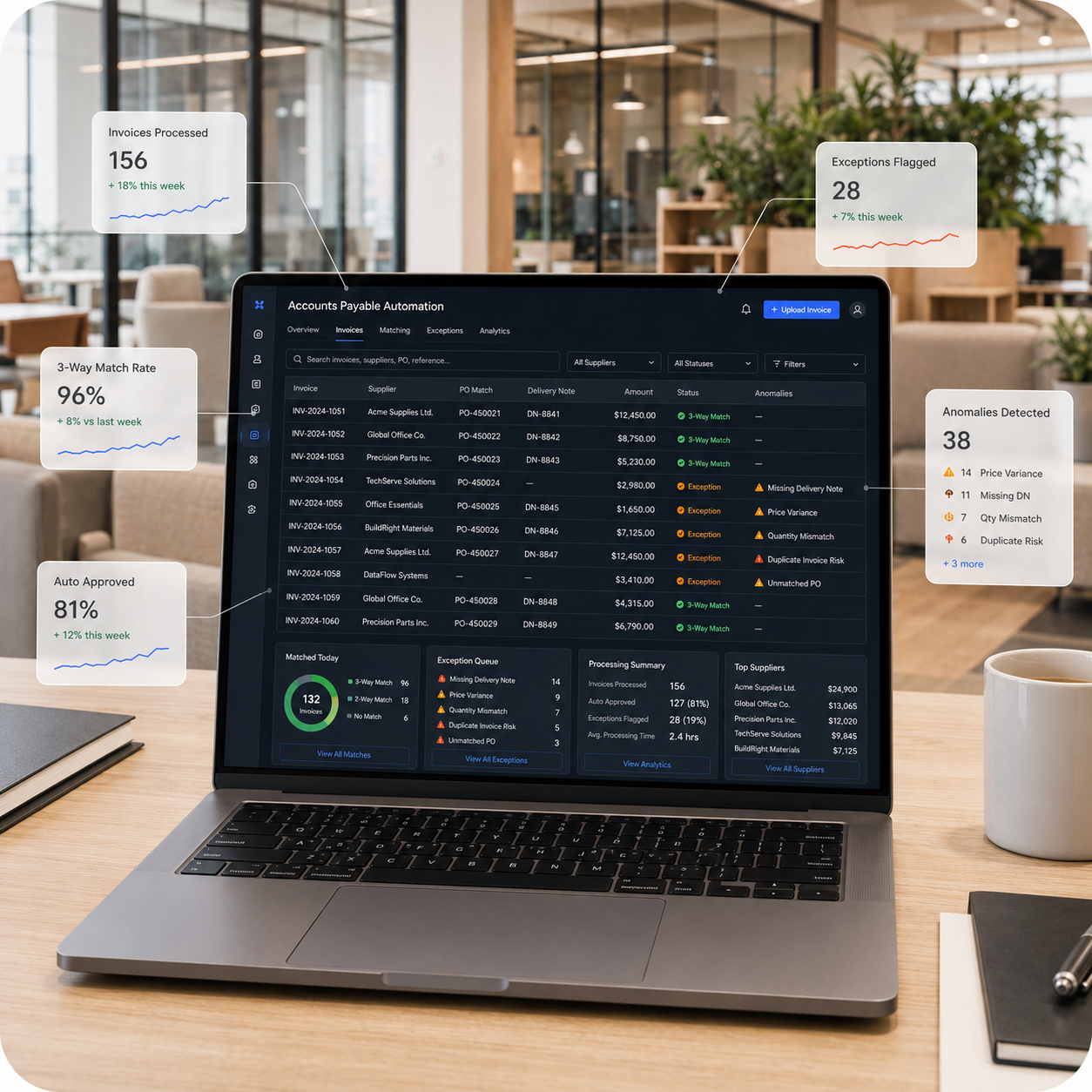
In practice, this often means invoice ingestion across email, EDI, and PDF; AI-driven extraction with confidence scoring; two-way and three-way matching with your purchase orders and goods received notes; approval workflows that mirror your real authority hierarchies; automated GL coding with human-in-the-loop oversight; and direct ERP write-back to whatever you actually run such as Microsoft Dynamics, SAP, Sage, Xero, NetSuite, Oracle, or custom systems. All built around how your finance operation works today, and designed to evolve as it changes.
With a decade experience of delivering enterprise systems on Microsoft Azure and .NET, our full in-house team has the experience to handle the messy realities most accounts payable automation projects break against, inconsistent supplier invoice formats, complex multi-PO matching, legacy ERPs nearing end-of-life, multi-entity and multi-currency operations, and the kind of edge cases that previous SaaS attempts may have stumbled over.
In over 10 years we have never failed to deliver a project. We can contractually guarantee yours will not be the first.
✓ You own the platform outright.
✓ No per-invoice fees that rise with your business.
✓ No vendor controlling the roadmap.
And when you are ready to extend AP automation into adjacent finance workflows such as expense management, supplier onboarding, or payment runs, you can do so faster and more cost-effectively because the foundations are already there.
Our accounts payable automation services
Built around your processes. Integrated with your ERP. Owned by you.
AP automation Discovery (free service)
Many AP automation projects fail because the wrong thing gets built, or the off-the-shelf product cannot handle the real complexity of the finance operation. We start with a free Discovery service which includes a structured workshops to understand your invoice volumes, supplier mix, matching complexity, tech estate, and the workflows where previous automation attempts may have struggled.
The output of Discovery is a clear, prioritised plan and high-level design of your AP automation, with real numbers, before any commitment to build.
Invoice capture and intelligent document processing
Multi-channel intake across email, EDI, supplier portal submissions, PDFs, and scanned paper. AI invoice processing and intelligent document extraction of header data, line items, totals, VAT, and PO references, with confidence scoring on every field. Built using tools such as Azure AI Document Intelligence and tuned to handle the supplier format inconsistency that often break generic OCR and most off-the-shelf invoice automation software.
The result is reliable automated invoice processing, even when your suppliers send wildly different invoice formats.
Two-way and three-way matching
Configurable matching logic between invoices, purchase orders, and goods received notes. Handles the cases that off-the-shelf tools struggle with such as multiple POs against a single invoice, single PO across multiple invoices, partial deliveries, inconsistent naming, blanket POs, freight charges, and tolerances that vary by supplier or commodity.
The result is automated matching for the majority of invoices, and precise flagging of only the specific areas requiring human review.
Approval workflows and segregation of duties
Approval routing built to mirror your real processes. Threshold-based approvals, conditional routing by GL code, cost centre, supplier, or invoice type. Full audit trails. Delegation rules. Out-of-office cover. The behaviour of a custom-built workflow, with the governance of an enterprise system.
The result is approvals that match how your finance function actually operates, not how a SaaS vendor thinks it should.
GL coding and ERP write-back
Automated GL coding suggestions trained on your historical coding patterns, with human-in-the-loop oversight for low-confidence cases. Direct write-back to your ERP and finance systems, including Microsoft Dynamics, Business Central, SAP, Sage, Xero, NetSuite, Oracle, and bespoke systems. Designed to work with current systems and adapt to future migrations.
The result is clean, accurate data flowing into your finance system of record without manual re-entry.
Supplier portal and statement reconciliation
Get a supplier-facing portal for invoice submission, status tracking, query management, and statement reconciliation. Reduces inbound supplier query volume significantly, gives suppliers visibility into payment status, and provides a structured channel for dispute resolution.
The result is fewer inbound calls and emails to your accounts payable team, and stronger supplier client relationships.
Long-term AP platform management
AP automation is not usually a one-off project. Our Continuity and Managed Service models keep your platform current as AI capabilities improve, your supplier mix changes, and your ERP estate evolves. Models can be swapped, matching logic refined, and new automations added. You retain full ownership at every stage.
The result is a platform that gets better over time, without lock-in to any single supplier.
Accounts payable workflows we automate
Within an accounts payable automation or invoice automation programme, these are the specific workflows we most commonly build for clients. Each automated invoice processing capability becomes faster and cheaper to deploy once the platform foundations are in place.
Invoice ingestion across all channels
Email, EDI, supplier portal upload, structured PDF, scanned paper, and direct integrations with high-volume suppliers. Routed and normalised into a single processing queue.
AI extraction with confidence scoring
Header data, line items, totals, VAT, and PO references extracted with confidence scores. Low-confidence fields automatically flagged for review.
Three-way match (invoice / PO / goods received)
Automated matching with configurable tolerances. Mismatches flagged with precise indication of the line, field, or amount in dispute, enabling reviews in seconds not hours.
Two-way match (invoice / PO only)
For services and non-stock items where there is no goods receipt. Same matching logic, adapted to the absence of a GRN.
Non-PO invoice routing and approval
Structured routing of non-PO invoices to the right cost centre owner for coding and approval, with full audit trails.
Duplicate invoice detection
Detection across supplier, amount, invoice number, and content similarity. Catches the cases that humans miss when working at volume.
VAT validation and tax code application
Validation of VAT numbers, tax codes, and reverse charge logic. Country-specific tax rules where you operate across multiple jurisdictions.
Supplier statement reconciliation
Automated reconciliation of supplier statements against your accounts payable ledger. Highlight key information such as missing invoices, payment timing differences, and outstanding queries.
Overdue invoice and payment chasing
Outbound chasing of overdue invoices and proactive supplier communication on payment status. Removes one of the highest-volume manual workloads from your AP team.
Multi-entity, multi-currency, multi-language AP
Single platform, multiple legal entities, multiple currencies, multiple languages. Designed in from day one rather than retrofitted as a premium tier.
How we deliver custom accounts payable automation faster than traditional bespoke solutions
Most finance leaders assume custom-built means slow and expensive. That used to be true, but our Cambrian BOP platform changes the equation. The foundations that most bespoke AP automation projects rebuild from scratch are already in place, so we configure and customise rather than start from a blank page. The speed gets close to SaaS configuration. The fit and the ownership are what bespoke has always delivered.
Cambrian BOP, the platform that does the heavy lifting
Cambrian BOP is our enterprise AI and automation platform, built on Microsoft Azure and .NET. It provides the foundational architecture every AP automation project needs: data ingestion, AI orchestration, approval workflows, security, governance, and ERP integration patterns. You own your implementation outright, and it runs on infrastructure your IT team already supports.
Accounts payable-specific frameworks honed in production
Invoice extraction patterns, automated invoice processing engines, intelligent document processing libraries, matching engines, approval workflow templates, supplier portal modules, and ERP write-back libraries already exist. They have been refined across our enterprise platform work and across AP-specific projects. We can configure them to your business rather than write them from scratch, which is where the speed comes from.
Endlessly customisable, never starting from scratch
Configuration often handles most requirements, but most AP processes have edges that don’t fit a template. Our team has over a decade of custom software development experience for enterprise clients, so when you need bespoke functionality or a module that doesn’t exist yet, we build it on top of Cambrian BOP rather than from a blank page. Even fully custom code starts with foundations already in place, which is what keeps truly bespoke work faster and dramatically cheaper than a greenfield build.
A hybrid architecture that works where pure AI fails
We have seen how off-the-shelf AI invoice processing tools and AI-only solutions fail at scale, particularly when supplier invoice formats are inconsistent and matching logic is complex. Cambrian BOP uses a hybrid architecture: AI extraction and intelligent document processing for the unstructured parts, structured business logic for the rules, and human-in-the-loop workflows for the exceptions. The combination is what makes high-volume automated invoice processing reliable.
The economics shift in your favour over time
The first AP automation use case proves the platform. The second costs less to deploy because the foundations are already there. By the time you have added expense management, supplier onboarding, payment automation, or other finance workflows, the platform has paid for itself many times over, with each new automation deployed faster and cheaper than the last.
Custom accounts payable automation vs SaaS AP automation
Most buyers evaluating accounts payable automation software arrive at this page having already looked at the named SaaS vendors. SaaS invoice automation software is a legitimate option for some operations. It is not the right option for every operation, and the trade-offs are not always made clear in the sales process. Below is a comparison, based on what we see when clients come to us having already tried, or fully evaluated, the SaaS route.
| Custom AP automation (Steer73) | SaaS AP automation | |
|---|---|---|
| Ownership | You own the platform, IP, data, and workflows | Vendor owns it. You rent access. |
| Pricing model | Capital investment plus low ongoing cost | Often fixed license fees or per-invoice and/or per-user fees, typically rising over time |
| Workflow fit | Built around how your AP team actually works | Generic workflows. Your team adapts to the tool. |
| ERP integration | Designed around your ERP estate, current and future | Pre-built connectors, limited to what the vendor supports |
| Complex matching logic | Whatever your business requires, including multi-PO and edge cases | Constrained to the vendor's matching engine |
| Multi-entity and multi-currency | Designed in from day one | Often a premium tier or workaround |
| Supplier format variability | Hybrid AI + business logic handles inconsistency well | Frequently the failure point at scale |
| Adjacent finance automations | Same platform can handle expenses, supplier onboarding, payment runs | Each typically requires a separate vendor or subscription |
| Exit cost | None. You own the system. | Migration risk, data extraction friction, supplier re-onboarding |
| Time to first deployment | Months, through Cambrian BOP | Weeks for the basic configuration |
| Vendor risk | Zero. You own a .NET / Azure asset with zero lock-in | High. A vendor can be acquired, pivot, or fail |
| 5-year cost trajectory | Predictable. Costs fall as foundations are reused. | Costs rise as users, invoices, and adjacent modules are added |
ERP and system integration for accounts payable automation
Integrations are key to making any AP automation software useful. A platform that cannot reliably read from and write to your ERP creates more manual work. We do not ship a fixed connector list. We design the integrations your specific stack needs, including the legacy and on-premise systems most off-the-shelf invoice automation software struggles with.
Example ERPs and accounting systems we can integrate with
| Microsoft Dynamics 365 Finance & Operations | Xero |
| Microsoft Dynamics GP (including legacy and end-of-life support) | Oracle NetSuite |
| Microsoft Dynamics Business Central | Oracle E-Business Suite and Oracle Fusion |
| SAP S/4HANA, SAP ECC, and SAP Business One | Workday Financials |
| Sage 50, Sage 200, Sage Intacct, and Sage X3 | Custom and bespoke ERP systems |
| Legacy on-premise and mainframe finance systems |
Data sources we connect
Supplier master data, chart of accounts, cost centre hierarchies, approval matrices, banking and payment systems, expense management tools, document repositories, EDI feeds, and supplier portal submissions. The integration layer normalises everything into a single processing pipeline, regardless of source format.
Our integration approach
API-first where APIs exist. File-based, EDI, and direct database integration where they do not. We design for the awkward realities of real enterprise IT estates, including on-premise legacy systems, hybrid cloud, and ERPs approaching end-of-life with a migration on the horizon. Built to work today and to be ready for tomorrow.
What a Steer73 accounts payable automation Discovery project looks like
Project example: Discovery for a leading UK supplier to the construction industry
Project example: Discovery for a leading UK supplier to the construction industry
A long-established UK distributor of technical products to the construction sector, operating across multiple group companies, was processing thousands of invoices per month. Standard reconciliations were taking up to 15 minutes each. The equivalent of four full-time staff in the finance team were absorbed handling invoice approvals, with no time left for higher-value work.
Two previous off-the-shelf invoice automation platforms had been trialled. Both had failed. The pattern was familiar: inconsistent supplier invoice formats, complex matching scenarios (multiple POs against single invoices and the reverse), and an inability of the off-the-shelf platforms to isolate the specific area of discrepancy when a mismatch occurred. Staff were forced into full manual reviews even when the platform had processed 95% of an invoice correctly.
The ERP environment added complexity. The client ran an ERP which was approaching end-of-life, with a migration in early evaluation. Any AP automation solution would need to integrate cleanly with the current ERP and remain compatible with the future one. Risk tolerance was low: errors introduced into the financial system can cascade through stock and pricing structures, making them costly to detect and resolve.
Steer73’s Discovery, conducted over structured workshops with finance, procurement, operations, and IT, produced a clear and prioritised accounts payable automation plan. The recommended architecture is a hybrid model: AI-driven intelligent document processing for the unstructured invoice content, structured business logic for the matching and validation rules, and clear human-in-the-loop workflows for exceptions where AI cannot be confident.
Built using Cambrian BOP, the solution was ERP-agnostic at the integration layer so the platform would stay useful through the upcoming migration. Modular by design so adjacent automations across the wider business, including the sales process, can be added on the same foundation later.
The expected outcome from the Discovery: a 50% to 70% reduction in manual reconciliation effort. Scalability without proportional headcount growth. A foundation for further automation across finance and beyond.
This is the kind of problem an off-the-shelf invoice automation product had failed to solve. A platform built around the real requirements of the business is the solution. Discovery makes the picture clear before any commitment is made.
Want to know what's possible for your business?
Request a free Discovery project for your accounts payable automation
Want to know what's possible for your business?
Request a free Discovery project for your accounts payable automation
Why choose Steer73 for your accounts payable automation
Guaranteed project success
In over 10 years of building enterprise systems, across 10+ countries and for some of the world’s largest companies, we have never failed to deliver a project. We can contractually guarantee yours will not be the first.
The combination of our Digital Transformation Platform, our Cambrian BOP framework, our zero-juniors hiring model, and our rigorous Discovery and Scoping methodology removes the failure modes that derail many AP automation projects.
Owned by you with no licence fees
Invoice extraction patterns, automated invoice processing engines, intelligent document processing libraries, matching engines, approval workflow templates, supplier portal modules, and ERP write-back libraries have already been considered. They have been refined across our enterprise platform work and across AP-specific projects. Any many cases, we can configure them to your business rather than write them from scratch, which is where the speed comes from.
Built around your actual accounts payable operation
We don’t deliver a fixed feature set you have to adapt to. They system we build will be configured to your matching rules, your approval hierarchies, your GL coding logic, your supplier portal needs, your ERP write-back requirements, and the edge cases that make your finance operation specifically yours.
Microsoft Azure foundation
A best-fit for most enterprise IT strategies. The lowest operational overhead, strongest long-term support, and regulated industry credentials that your IT and compliance functions already recognise. Your AP platform will run on infrastructure your team already supports, with security and governance models you already trust.
A platform that grows beyond accounts payable
Invest in AP automation today, get the foundation for expense management, supplier onboarding, payment automation, and other finance use cases tomorrow. Each new automation costs less to deploy because the platform foundations are already in place. The asset on your balance sheet compounds in value over time, rather than being a recurring cost line that grows.
How to engage us on your accounts payable automation project
Accounts payable automation projects vary in scope, governance, and pace. We offer three engagement models so you can align delivery with your internal processes, budget controls, and risk appetite.
Many clients start with one model for the initial build and move to a different model for long-term platform management.
Fixed price model
Fixed price, fixed scope.
Best for clearly-defined initial accounts payable automation builds where you need budget certainty before development begins. Suitable when the project needs board or CFO approval against a hard number.
Any scope variations are handled through a formal change-request process so cost remains controlled throughout. This is a common starting point for the initial platform deployment and first business unit rollout.
Time & materials
Fixed budget, adjustable scope.
Best when requirements are likely to evolve during delivery, which can be the case as new AP workflow edge cases come into view. Regular releases with continuous feedback, and full cost transparency throughout. Scope and priorities can adjust as the platform proves itself and the business sees what becomes possible.
Managed service model
Long-term development partnership.
A dedicated Steer73 team works as your extended product development capability, delivering improvements, maintenance, and new use cases as your business evolves.
Lower day rates than project engagements. Teams scale up or down based on priorities.
A common model for clients that develop beyond the initial AP automation build, because the platform keeps producing new value year after year.
How much does an enterprise AI platform cost?
The honest answer: it depends. Cost varies based on the scope of the initial deployment, the number and complexity of integrations, the AI use cases being deployed, and your ongoing management model. There is no fixed price list, because no two enterprise AI platforms are the same. What we can tell you is that the initial platform foundation plus first business area is the typical starting investment, and that our free Discovery service will give you a real estimate before any commitment.
What affects the cost?
Invoice volume and document type mix
From a few hundred invoices a month to tens of thousands. PDFs only, or a mix of EDI, PDF, scanned paper, and email-embedded invoices. Volume and mix drive the architecture and the AI extraction tuning effort.
Number and complexity of integrations
Connecting to one ERP can be straightforward. Connecting to a fragmented estate with multiple ERPs, a separate WMS, banking platforms, expense tools, and supplier portals takes longer and costs more, but can be where the highest ROI lies.
Complexity of matching and approval rules
Simple two-way matching against a clean PO file is one thing. Three-way matching across blanket POs, partial deliveries, freight charges, and supplier-specific tolerances is another. Approval workflows with conditional routing across legal entities and cost centres add further scope.
Number of legal entities, currencies, and languages
A single-entity, single-currency operation can be straightforward. Multi-entity, multi-currency, multi-language AP across European or global operations adds to the design and testing effort.
Supplier portal and external-facing requirements
A simple internal-only solution is one cost profile. A supplier portal with self-service status tracking, statement reconciliation, and dispute resolution capability is another.
Ongoing management model
Continuity Services for support and monitoring, Managed Service for ongoing development, or hand-over to in-house teams all have different ongoing cost profiles. The right model depends on your internal capability and the rate at which you want to add new use cases.
For a real number tailored to your specific situation, our free Discovery service is the starting point.

“The team at Steer73 are extremely well versed in their fields and regularly provide informative updates on technology and external industry trends, which we can translate to benefit our customers and anticipate challenges.”

“Steer73 have offered us a high-quality service from the beginning of the project, working with us to analyse where our current range of digital products were successful and where they were failing, providing both the tools and the encouragement to grow our business.”
What our clients say about us
Meet us in London or give us a call
London office: Steer73 – Custom accounts payable automation services, London
167-169 Great Portland St (5th Floor), London, W1W 5PF, United Kingdom
Phone number: +44 2038 550 237
Email: hello@steer73.com
1. Initial consultation
A short, no-pressure call to discuss where you are with AP, what is painful, and what you have already evaluated. We will give you early guidance on whether custom AP automation is the right fit for your situation, and what good would look like.
2. Free discovery project
A structured deep dive into your AP operation, your supplier mix, your ERP estate, your matching complexity, and your integration needs. You leave Discovery with a clear architectural plan, a prioritised rollout, and a real cost estimate for the work.
3. Clear comparison and final decision
With the Discovery output, you can compare custom-built AP automation against your SaaS shortlist with real numbers, on a like-for-like basis. You have everything you need to make an informed final decision, with no obligation to proceed.
Articles related to accounts payable automation

Custom software is cheaper than SaaS
Why the total cost of ownership of an owned platform almost always beats SaaS over a five-year horizon.

Automating PDF data extraction with AI and Azure
A technical look at how Azure AI Document Intelligence and orchestration patterns make AI-powered document automation production-ready.

Your AI is not as smart as it could be
Why most enterprise AI initiatives underperform, and what to do about it.
FAQs: accounts payable automation, London
The initial AP automation platform plus first business unit is typically delivered in two to four months, depending on volume, integration scope, and matching complexity. Most clients start with a single business unit, prove ROI quickly, then roll out across other entities or workflows on the same platform foundation. Each subsequent phase is significantly faster because the platform is already in place. Our free Discovery service produces a real timeline estimate based on your specific situation.
Costs vary based on your scope. What we consistently see is that custom-built AP automation is often a fraction of multi-year SaaS license spend. SaaS pricing models tend to rise, with per-invoice fees, per-user licences, and per-module add-ons that grow with the business. Custom-built has a higher initial investment but flat (and usually much lower) ongoing costs, and you own the platform outright. Our free Discovery service produces a real cost comparison tailored to your situation.
SaaS AP automation software is a rental model. The vendor owns the platform, your data sits on their infrastructure, and the workflows are generic to all their customers. Custom-built AP automation is built specifically for your business, owned by you, integrated with your specific ERP estate, and configured to your actual matching and approval logic. SaaS invoice automation software is oten the right answer for smaller operations with standard processes. Custom is typically the right answer for businesses with real volume, complex matching, multi-entity operations, or strategic ambitions beyond AP automation alone.
There are some common reasons off-the-shelf AP automation tools fail: they cannot handle inconsistent supplier invoice formats, their matching engines cannot cope with multi-PO or edge-case scenarios, and when discrepancies occur they cannot isolate the specific area of mismatch, forcing full manual reviews. Custom-built AP automation uses a hybrid architecture, AI extraction for the unstructured content, structured business logic for the rules, and human-in-the-loop workflows for exceptions that AI can’t confidently handle. This is what makes it reliable at scale where pure AI or pure rule-based solutions break.
We can integrate with almost any system. Common integrations include Microsoft Dynamics 365 Finance & Operations, Dynamics GP, Dynamics Business Central, SAP (S/4HANA, ECC, Business One), Sage (50, 200, Intacct, X3), Xero, Oracle NetSuite, Oracle E-Business Suite, Workday Financials, mainframe finance systems, and custom or legacy on-premise platforms. Our integration approach is designed to handle the messy reality of real enterprise IT estates, including systems approaching end-of-life with a migration on the horizon.
This is the failure mode many off-the-shelf AP automation software and invoice automation tools stumble on, and it is one of the specific reasons custom-built can outperform SaaS solutions. Our AI invoice processing layer uses intelligent document processing built to handle variable supplier formats, with confidence scoring on every field so human reviewers focus only on what genuinely needs review. Combined with structured business logic for matching and validation, the platform handles supplier format variability that breaks pure AI or pure template-based approaches.
This can be built in from the start. Every action can be logged with the user, timestamp, and decision context. Segregation of duties is enforced through configurable approval hierarchies and role-based access controls. The Microsoft Azure foundation provides an enterprise-grade security baseline with audit logging, transparent workflows, and human-in-the-loop oversight. We have worked with regulated clients where this sort of functionality is non-negotiable.
Yes. Multi-entity, multi-currency, multi-language AP can be designed in from the start rather than retrofitted as a premium tier. The same platform can handle consolidated approval workflows across legal entities, currency conversion and revaluation, and supplier-facing communication in multiple languages.
This is a common situation. Our accounts payable automation platform is designed to be ERP-agnostic at the integration layer, meaning it works with your current ERP today and remains compatible with your future ERP after migration. You do not have to delay AP automation until after the ERP migration, and the AP platform does not have to be rebuilt when the ERP changes.
Yes, and this is one of the strongest reasons to build custom rather than rent SaaS. The platform foundations established for accounts payable automation and invoice automation, such as data ingestion, AI orchestration, approval workflows, ERP integration, and security, are reused for adjacent finance workflows like expense management, supplier onboarding, payment runs, statement reconciliation, and others. Each additional automation costs less to deploy because the platform is already there.
Ready to compare custom accounts payable automation against your shortlist?
You are probably evaluating multiple options. A free Discovery project with Steer73 produces a real architectural plan, a real cost estimate, and a real timeline tailored to your specific AP operation. That gives you an apples-to-apples comparison against whatever SaaS vendors are on your shortlist, with no commitment to proceed.